
Top Government & Municipal WordPress Themes for 2026
Government and municipal websites have a different standard to meet than a marketing site for a software startup. Accessibility isn’t optional — in most jurisdictions it’s a legal requirement. The information architecture needs to handle departments, public notices, events, and services without turning into a navigation disaster. And the site needs to work for a 65-year-old on a slow connection as reliably as it does for a city council member on a laptop in a meeting room.
Most WordPress themes aren’t designed with any of that in mind. We tested four that are — looking specifically at WCAG accessibility implementation, Events Manager integration, department and agency layout systems, multilingual support, and the kind of Elementor flexibility that lets a city’s communications team make updates without a web developer on call.
Here’s what we found.
What actually matters for a government or municipal WordPress theme
A few requirements that separate a genuinely suitable government theme from one that just looks official:
- Accessibility (WCAG 2.1 AA as a minimum). Color contrast ratios, keyboard navigation, ARIA labels, focus indicators — this is the compliance layer. A theme that doesn’t document WCAG conformance is a risk, not a starting point.
- Events Manager integration. City calendars, council meetings, public hearings — these aren’t blog posts. A dedicated events system that handles recurring events, registration, and department filtering is standard infrastructure for any municipality.
- Department and agency section templates. Navigating from a city homepage to the Parks Department to a specific permit application is a distinct page architecture problem. Generic themes treat it as a category page; good government themes treat it as a service delivery problem.
- Public notices and announcements. Time-sensitive content with specific formatting requirements — not just a blog widget. Dedicated announcement sections with expiry dates and urgency indicators are worth having built in.
- Multilingual support. Cities with significant non-English-speaking populations need proper multilingual implementation — WPML at minimum, Polylang for the budget-conscious.
1. TheGov — Best Government WordPress Theme Overall

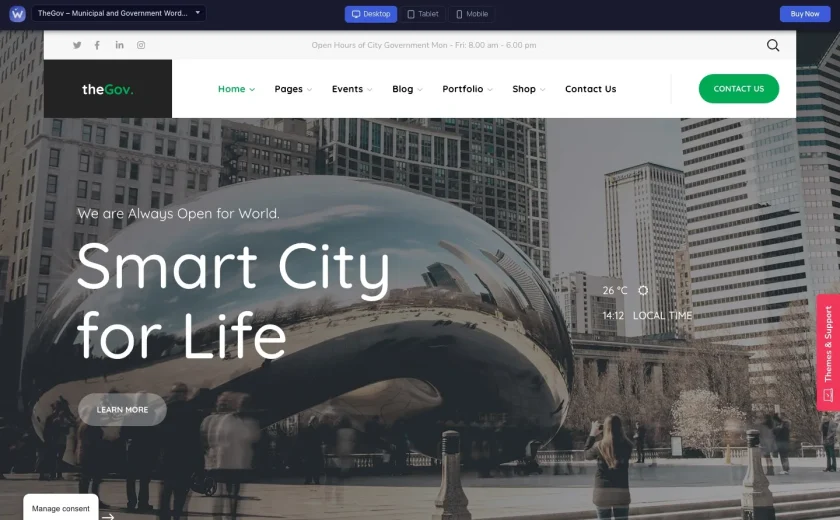
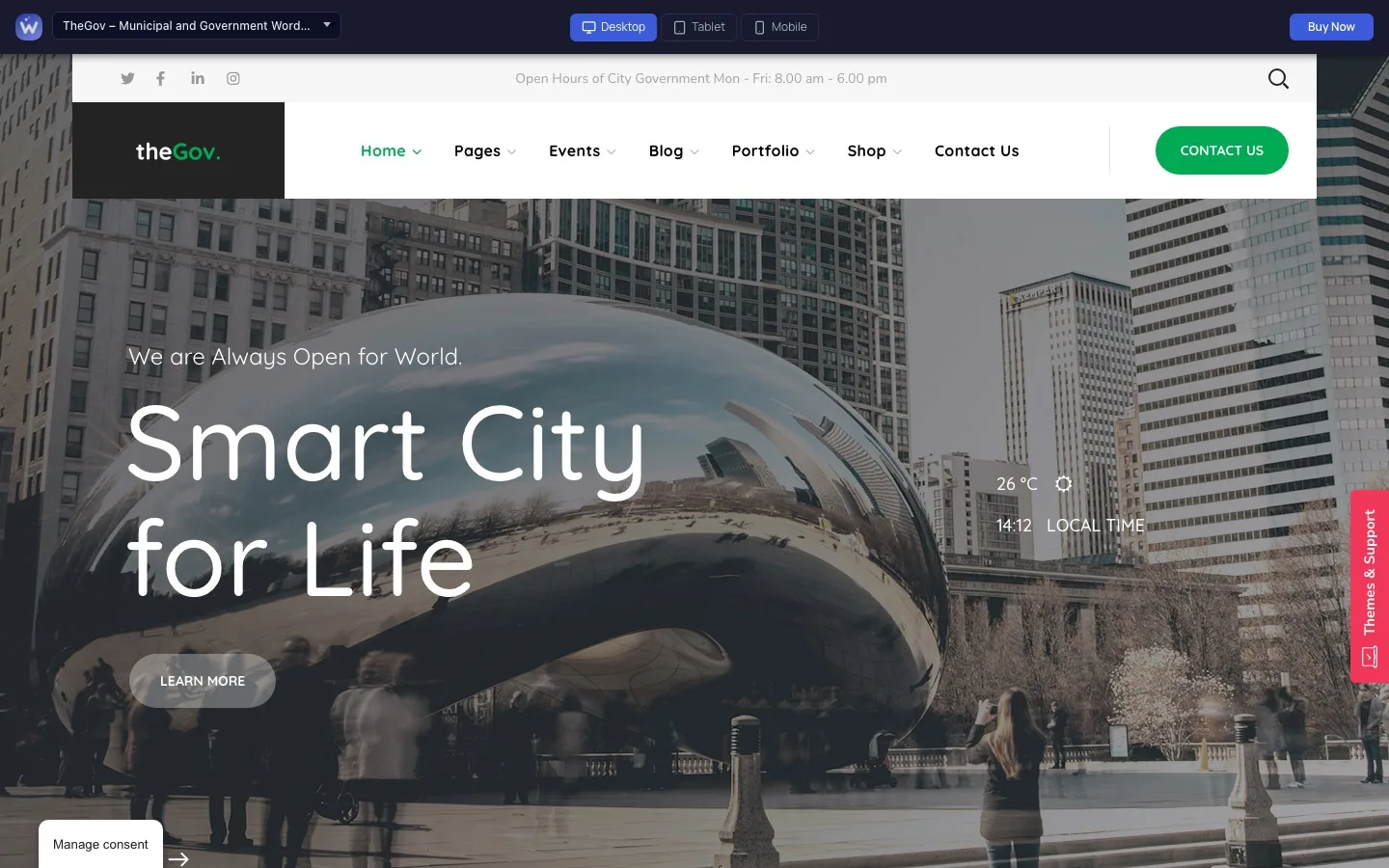
TheGov was designed for public sector organizations — not adapted from a corporate theme by adding a “government” demo. The difference shows up immediately in the layout priorities: the homepage is structured around service discovery rather than brand storytelling, the navigation accommodates deep department hierarchies without collapsing into an inaccessible mega-menu, and the event integration is a first-class feature rather than a plugin you bolt on.
Events Manager plugin is included and pre-configured for the government use case — department-filtered calendars, recurring event support for council meetings, public hearing registration, and a calendar view that works on mobile without falling apart. For a city or county site where citizens need to find upcoming meetings and public comment periods, this is infrastructure that would take hours to set up properly with any other theme.
The accessibility implementation is thorough. TheGov documents WCAG 2.1 AA conformance — color contrast ratios are validated, keyboard navigation works through the full interface, ARIA labels are in place, and focus indicators are visible. This isn’t a checkbox — it’s the legal baseline for most public sector organizations in the US and EU, and it’s built in rather than requiring an accessibility overlay plugin that creates its own compliance problems.
Department and agency section templates cover the standard public sector structure: individual department pages with contact directories, service listings, staff sections, related documents, and breadcrumb navigation that keeps users oriented in a complex hierarchy. Public notices and announcements have their own dedicated section type — with urgency indicators, date-range display, and an archive — separate from the news blog. That distinction matters for compliance in many jurisdictions.
The 50+ Elementor widgets include city portal-specific components: service access cards, permit application links, document download sections, citizen FAQ blocks, and stat counters for things like population, service coverage, or budget figures. The header and footer run through Elementor Theme Builder — full visual control, per-page conditions. Translation is fully handled: .pot file included, WPML and Polylang both tested, no hard-coded strings.
Support runs 12 months, child theme is included, one-click demo import works, and the 14-day money-back guarantee gives a public sector IT team the time to validate the theme against their requirements before committing.
Key features
- Events Manager plugin included — department-filtered calendars, recurring events, public hearing registration
- Accessibility-ready design: WCAG 2.1 AA conformance, keyboard navigation, ARIA labels, focus indicators
- Department and agency section templates with contact directories, service listings, document downloads
- Public notices and announcements section with urgency indicators and archive
- City portal layouts: service discovery homepage, permit application links, citizen FAQ
- 50+ Elementor widgets including government-specific components
- Elementor Theme Builder — full header & footer control, per-page conditions
- Translation-ready: .pot file, WPML & Polylang tested
- WooCommerce-ready, child theme included, one-click demo import
- 14-day money-back guarantee, 12 months support, WordPress 7.0 compatible
Who it’s for
City councils, county governments, municipal portals, government agencies at state and federal level, public sector organizations in any jurisdiction, and the web agencies and contractors that build sites for them. The WCAG implementation and Events Manager integration make it the only theme here that can be deployed for a regulated public sector client without significant additional accessibility work.
2. CityGov — Established Option with Elementor Pro
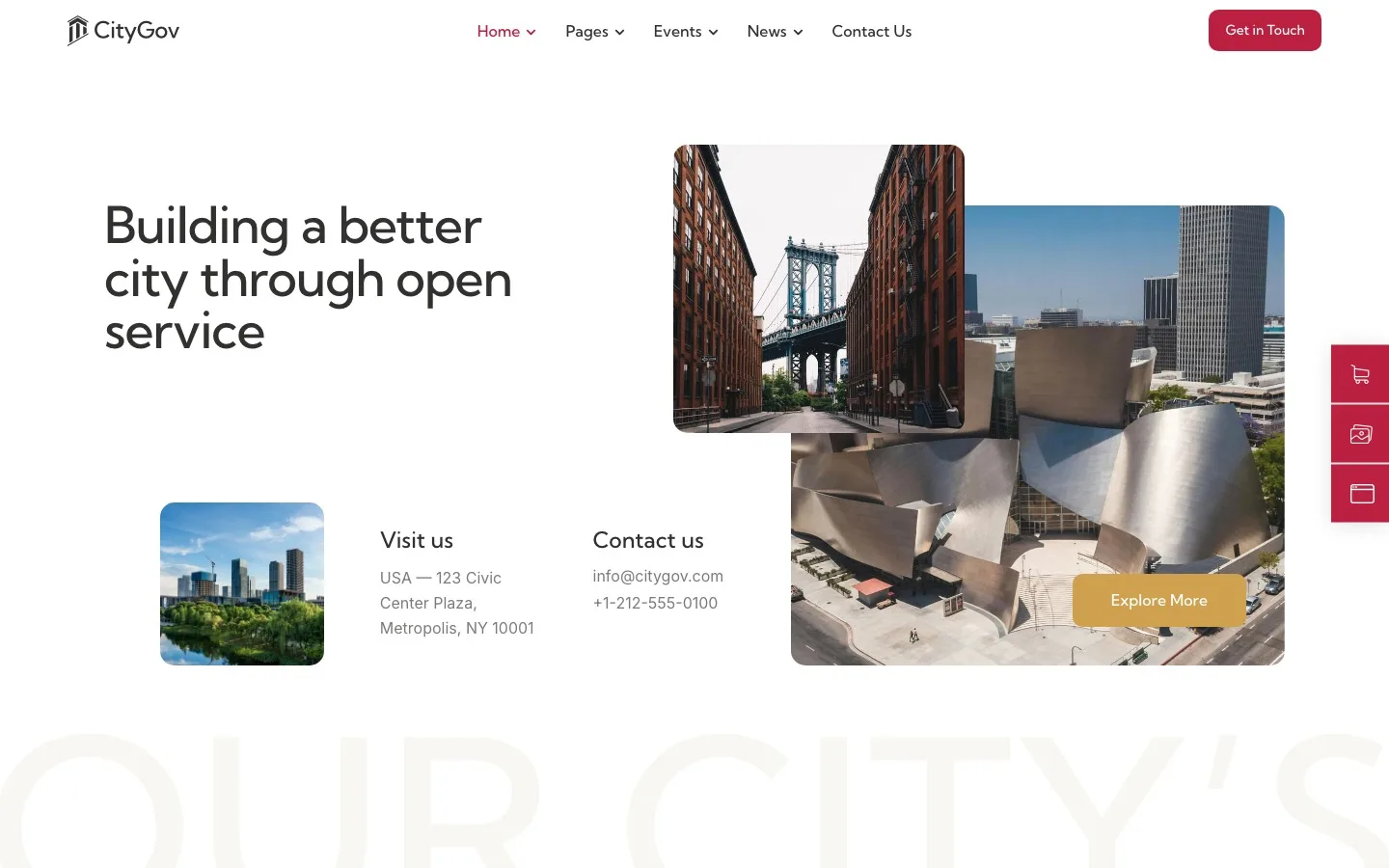
CityGov by AncoraThemes is the longest-running government theme on ThemeForest with active updates — longevity in this niche is meaningful, because public sector clients want vendors that will still be maintaining the theme in two years. The design is conservative by design: readable at text-heavy densities, structured for navigation hierarchies that can go five levels deep.
Elementor Pro powers the page builder, which gives you more Elementor widget access but adds a dependency on a paid plugin — worth knowing if the client budget doesn’t include Elementor Pro. WCAG accessibility is addressed in the documentation but not as thoroughly specified as TheGov’s conformance notes. Events integration is available but requires configuration rather than coming pre-configured.
Key features
- Long-standing government/municipal theme with established update history
- City council, government, and municipal portal layouts
- Elementor Pro page builder
- Department and agency section templates
- WPML compatible
- 6 months support (extendable to 12)
3. Mayorx — Modern Design for City and Municipal Sites
Mayorx brings a more contemporary design aesthetic to the government niche — cleaner visual hierarchy, larger typography, more white space than the traditional government portal look. For a forward-thinking city administration that wants to signal digital modernity rather than institutional conservatism, the aesthetic is a genuine differentiator.
The layouts cover the standard government page types, Elementor handles page building throughout, and the overall configuration experience is straightforward. Where it’s less developed than TheGov: the Events Manager integration isn’t included out of the box, and the accessibility documentation is less detailed. A solid choice for a municipal site that prioritizes visual modernity over deep feature depth.
Key features
- Modern design aesthetic for city and municipal sites
- Municipal and city government page layouts
- Elementor page builder
- WPML compatible
- One-click demo import
- 6 months support (extendable to 12)
4. Govity — Functional Budget Option for Smaller Government Sites
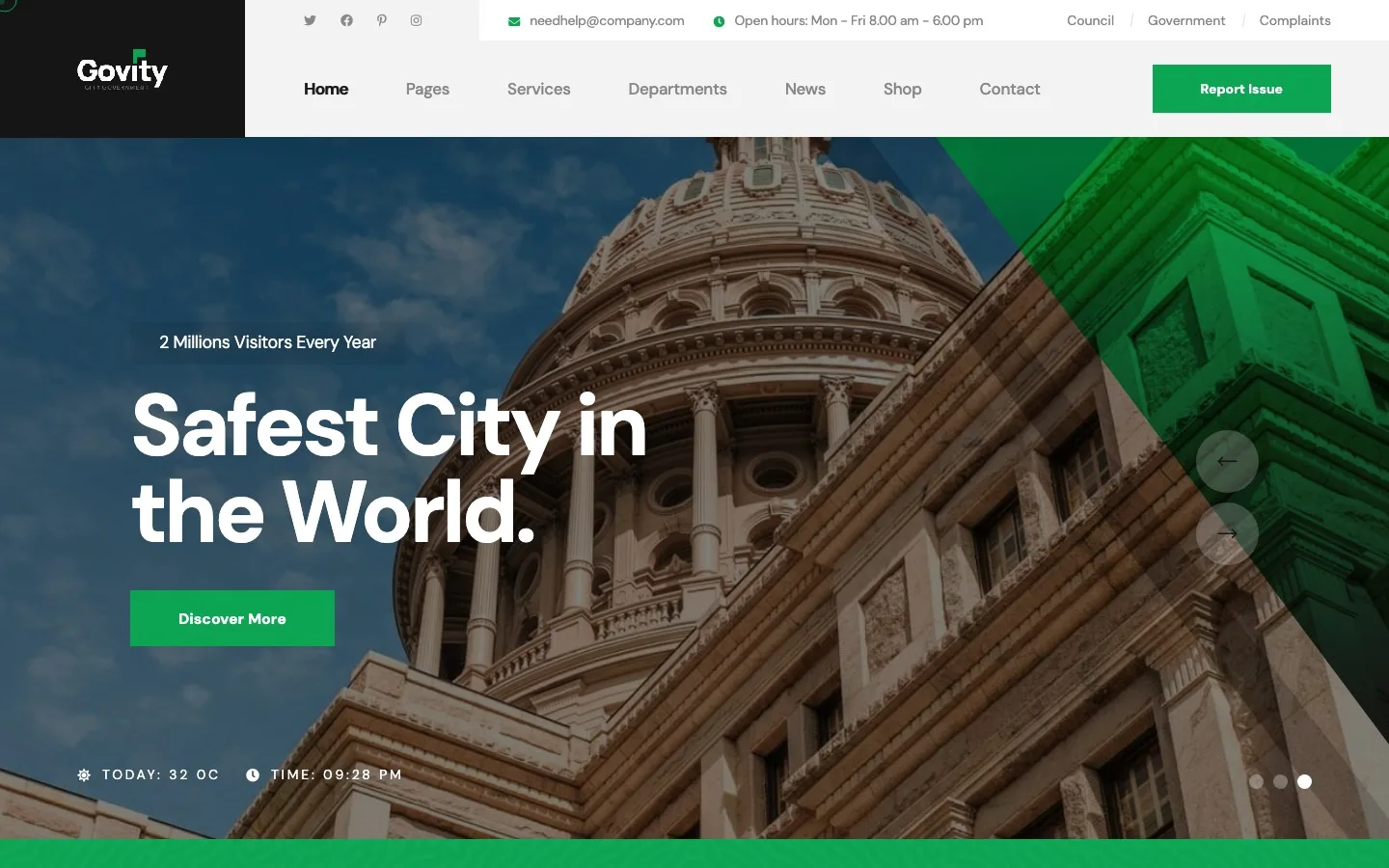
Govity handles the essential requirements for smaller public sector sites — government-appropriate visual design, Elementor page builder, basic service and department layouts, and a feature set that won’t overwhelm a small team managing the site part-time. The design is appropriately official without being heavy to configure.
For larger municipalities or sites with real accessibility compliance requirements, Govity’s documentation is less specific than TheGov’s — and the Events integration requires third-party plugin work. Best suited to small town governments, local agencies, or nonprofit public organizations that need to look official without a large web budget.
Key features
- Municipal and government-appropriate layouts
- Elementor page builder
- Basic service and department sections
- WPML compatible
- 6 months support (extendable to 12)
Side-by-Side Comparison
The differences that matter most here are Events Manager integration, documented WCAG conformance, and the depth of department/agency layout templates. Design quality is broadly adequate across all four — government sites don’t need to be beautiful, they need to be usable.
| Feature | TheGov Best Pick | CityGov | Mayorx | Govity |
|---|---|---|---|---|
| Price | from $29.99 / site | $49 | $49 | $49 |
| Page builder | Elementor | Elementor Pro | Elementor | Elementor |
| Inner page templates | 30+ | — | — | — |
| Total widgets / modules | 50+ | — | — | — |
| Elementor header builder | ✅ Theme Builder | ✅ Elementor Pro | ✅ | ⚠️ |
| Elementor footer builder | ✅ Theme Builder | ✅ Elementor Pro | ✅ | ⚠️ |
| Translation-ready (.pot) | ✅ | ✅ | ✅ | ✅ |
| WPML | ✅ | ✅ | ✅ | ✅ |
| Polylang | ✅ | ❌ | ❌ | ❌ |
| WooCommerce | ✅ | ✅ | ⚠️ | ⚠️ |
| Child theme included | ✅ | ✅ | ⚠️ | ⚠️ |
| One-click demo import | ✅ | ✅ | ✅ | ✅ |
| Support period | 12 months | 6 months | 6 months | 6 months |
| Money-back guarantee | ✅ 14 days | ❌ | ❌ | ❌ |
| Events Manager integration | ✅ included & pre-configured | ⚠️ requires setup | ⚠️ requires plugin | ⚠️ requires plugin |
| Accessibility (WCAG) | ✅ WCAG 2.1 AA documented | ⚠️ partially documented | ⚠️ not specified | ⚠️ not specified |
| Department / agency layouts | ✅ full template set | ✅ | ⚠️ basic | ⚠️ basic |
| Public notices section | ✅ dedicated section type | ⚠️ | ❌ | ❌ |
⚠️ = partial support or not confirmed in official documentation at time of writing. ❌ = not listed as supported. Always verify against the theme’s latest changelog before purchasing.
Which one should you pick?
For any regulated public sector organization — TheGov. The WCAG 2.1 AA conformance documentation, built-in Events Manager with pre-configured government use cases, dedicated public notices section type, and full department/agency template set make it the only option here suited to a site with real compliance requirements. The 12-month support window and 14-day money-back guarantee are meaningful for a procurement-process environment.
If the client values longevity and established track record — CityGov. It’s been on ThemeForest longer than any of the others, has an update history that suggests ongoing maintenance, and the Elementor Pro foundation is reliable. Note the Elementor Pro dependency and the less-specified WCAG documentation.
If the design aesthetic is the differentiator — Mayorx. For a city administration that wants to look modern and digitally forward, the visual design is genuinely better. Feature depth is lighter, but for a smaller municipality without complex compliance requirements, it’s a credible choice.
For small towns, local agencies, or tight budgets — Govity. Gets the basics done. For a site that needs to look official without requiring deep government-specific functionality, it’s adequate.
FAQ
What is the best government WordPress theme?
TheGov by WebGeniusLab — it’s the only theme in this roundup with documented WCAG 2.1 AA compliance, Events Manager pre-configured for government use, a dedicated public notices section, and full department and agency template sets. See the full demo here.
Do government websites need to be accessible (WCAG)?
In most jurisdictions, yes — and the requirements are getting stricter. In the US, Section 508 requires federal agencies to meet WCAG 2.0 AA, and many state and local governments follow suit. The EU Web Accessibility Directive requires WCAG 2.1 AA for public sector bodies. The UK’s GDS standard similarly mandates WCAG 2.1 AA. A theme that documents conformance — like TheGov — gives you a proper starting point. Overlays and add-on plugins that claim to fix accessibility after the fact create their own compliance problems.
Can I use WordPress for a city council website?
Yes — WordPress is widely used for government websites at city, county, and state levels. It’s open source, well-supported, and has themes specifically built for the public sector use case. TheGov provides the page architecture, Events Manager integration, and accessibility foundation that a city council site typically needs. The CMS editing interface is also simple enough for non-technical staff to use for content updates.
What features does a municipal website need?
At minimum: an events calendar with recurring event support, department and service pages with clear information architecture, a public notices section, accessible design (WCAG compliance), multilingual support for communities with non-English-speaking populations, and a mobile-responsive layout. TheGov addresses all of these — Events Manager is included and pre-configured, department templates are purpose-built, WCAG 2.1 AA is documented, and both WPML and Polylang are supported.
Bottom line
Government websites aren’t optional projects — they’re infrastructure that citizens depend on. That requires a theme with real accessibility documentation, events integration that works for a city’s calendar without a plugin configuration project, and department layouts designed around how public sector organizations actually structure their services.
TheGov is the only theme in this roundup that checks all of those boxes without additional work. The 14-day money-back guarantee gives procurement teams time to evaluate it against their requirements before the purchase is final.